DG 001 · The Open Table · Specimen
The Cost of Being Wrong Slowly
On the asymmetry between errors that announce themselves and errors that do not
Part 0 — What this specimen is
This work does not exist. It is placeholder text written to exercise a typographic system: numbered premises, glosses, epistemic tags, callouts, footnotes, a table, a blockquote, and a reference list. Its arguments are constructed to be shaped like arguments rather than to be true, and no claim in it should be cited, repeated, or believed.1
What follows is nonetheless written straight. A specimen that hedges every sentence does not stress the typesetting the way real prose does — the line breaks fall differently, the rhythm of a hedged paragraph is not the rhythm of an argued one, and a system that looks composed on cautious text can still fall apart on confident text.
The shape of the claim
The claim has three parts, and their modality differs. The first is a definition and is true by construction literal. The second is a claim about a class of dynamical systems and is exact only within a model that has not been built model-relative. The third transfers the result to human institutions and is, at present, a figure of speech doing structural work analogy. Readers who accept the first two and reject the third have understood the paper correctly.
Part 1 — The premises
Premise 1. Every decision system has a detection latency: the interval between committing an error and registering that an error was committed.
Latency is a property of the system, not of the error. The same mistake made inside two different institutions will surface at two different times, and the difference is structural rather than moral. Nothing here requires that anyone behaves badly.
Premise 2. Detection latency and error rate are independent parameters.
This is the load-bearing premise and the least intuitive. It is tempting to assume that careful systems are both accurate and quick to notice, and that sloppy ones are neither. But care spent on avoiding errors is care not spent on surfacing them, and the two budgets compete. A body that deliberates for eighteen months before acting has bought a lower error rate with a longer latency, and has not been told the price defeasible.
Premise 3. The cost of an error grows with the time it remains uncorrected, and grows faster than linearly.
An error that persists is not merely an error that persists. Decisions are taken on top of it; the structures built on the mistake must themselves be unwound; and the people who acted in good faith on the false premise acquire a stake in its remaining true. This compounding is the whole of the argument.
Premise 4. A system cannot reliably measure its own detection latency.
The measurement requires knowing when the error began, which is available only after detection, and only through the same faculties that failed to detect it. Self-reported latency is therefore systematically understated — not through dishonesty, but because the clock is started when the alarm rings.
Premise 5. Openness lowers latency at a cost that is visible, and closure raises it at a cost that is not.
Admitting an outside challenge is expensive in a way everyone can see: it takes time, it is uncomfortable, and someone must answer. Refusing one is expensive in a way nobody can see, because the bill arrives later and is itemised under a different heading. Budgets respond to visible costs.
Premise 6. Where latency is unmeasured and closure is cheap, latency drifts upward.
Given Premises 4 and 5, no correcting pressure acts on latency. A quantity under no pressure and subject to a one-way cost gradient does not stay where it was put model-relative.
Part 2 — The conditional result
Statement
If Premises 1 through 6 hold, then for any decision system that does not measure its own detection latency, expected total error cost rises over time even where the error rate is falling.
The result is conditional and the condition is strong. Premise 2 in particular is stated here without support and would need a model to earn defeasible. What the result offers is not a fact about the world but a place to look: if you wish to refute the argument, Premise 2 is where to aim, and the refutation would be surgical rather than rhetorical.
Why the falling error rate is a trap
The trap is that a falling error rate is observable and a rising latency is not. An institution watching its own dashboards sees improvement. It is not lying. It is measuring the quantity it can measure, and that quantity is genuinely getting better.
The most dangerous instrument is not the one that reads wrong. It is the one that reads right about the wrong thing, because no amount of care in reading it will reveal the error.
A worked comparison
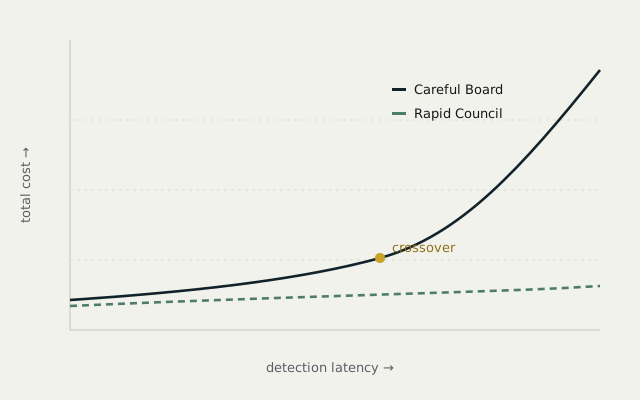
Two fictional bodies, each deciding one hundred matters a year.
| Body | Errors per year | Median latency | Compounding factor | Annual error cost |
|---|---|---|---|---|
| The Rapid Council | 12 | 3 weeks | 1.1× | 13.2 units |
| The Careful Board | 4 | 40 months | 6.5× | 26.0 units |
| The Careful Board, year 10 | 3 | 61 months | 9.4× | 28.2 units |
The Careful Board is three times more accurate and twice as expensive. By its tenth year it has improved its accuracy again and become more expensive still, because the latency drifted further than the error rate fell. Every number in this table is invented.2
Part 3 — Objections that survive
Three objections are strong enough to be worth stating, and none is answered here.
Latency is not one number. Different classes of error surface on different clocks within the same institution. Treating latency as a scalar is a modelling convenience that may not survive contact with a real body model-relative.
Some errors should not be corrected quickly. A system that reverses itself on every challenge has not lowered its latency; it has abolished its memory. There is a floor below which responsiveness becomes instability, and this specimen does not locate it.
The compounding factor is doing all the work. Premise 3 asserts faster-than-linear growth without saying how much faster. Choose a gentle enough curve and the result disappears. This is the honest weakness of the argument defeasible.3
Part 4 — What would settle it
A dynamical model in which latency and error rate are separately tunable, run to see whether the cost curves cross where the argument says they cross. Until such a model exists, the transfer from dynamical systems to human institutions is carried by the word “like”, and the word “like” is not a mechanism analogy.
The specimen therefore ends where a real paper of this shape would end: with the claim stated precisely enough to be attacked, the weakest premise named, and the experiment that would settle it described but not performed.4
References
- Placeholder, B. (2024). Latency and the Illusion of Improvement. Journal of Things That Do Not Exist, 12(3), 44–61.
- Specimen, A. & Placeholder, B. (2025). Six Premises About Nothing in Particular. Proceedings of the Imaginary Society for Decision Structure, 7, 112–140.
- Fictitious, C. (2023). On Instruments That Read Right About the Wrong Thing. Nowhere University Press.
- Invented, D. (2026). Against Scalar Latency. Unpublished specimen manuscript.
Footnotes
-
Every reference in this specimen is fabricated, and deliberately so — no venue named here exists, and no digital object identifier is given anywhere in this work. A specimen that cited real sources would eventually be quoted as though it had. ↩
-
The compounding factors were chosen to make the table legible rather than to model anything. A real version of this table would need its units defined, which would take a section of its own. ↩
-
This is the objection the authors would raise first if the paper were someone else’s, which is generally the test worth applying. ↩
-
The structure — claim, premises, conditional result, surviving objections, the experiment not yet done — is the point of the specimen. It is the shape the canon’s long-form papers are expected to take. ↩