
Canon number 001Essay I
The Democracy Tree
- Authors
- Chris Forman
- Series
- Origin · Essay I
- Kind
- Essay
- Version
- v1.0
- Date
Abstract
An overture to the entire Deliberation Gateway publication series. Starting with ants, we describe how a vote carries only two or three bits of information. We observe a pot of cotton tags in Cambridge that help us expand the logic to an argument for sortition, and we encounter deliberation as a way of making slow thinking happen, both in general and for the sector assembly. The main purpose of this essay is to introduce the main themes and Deliberation Gateway publication series that follow.
The colony
An ant colony has no parliament. Ants do not vote, campaign or read manifestos to each other, yet the colony can build ventilated cities, farm fungus and defend its territory with a coherence that most human institutions would envy. Its secret is not intelligence but process. Each ant leaves a chemical trace as it works, and the traces left behind by thousands of others tell each ant what to do next. Biologists call this stigmergy. No single ant sees the entire nest, and none of them need to. The chemical signalling is so cheap that every worker takes part while it works, so that—for the colony— communicating and working are one and the same act. Colonies whose process worked well survived; the rest are long gone.
I have spent most of the last decade wondering what the human equivalent would look like.
Two bits
Our main tool for communicating our individual desires to the state is the vote. Choosing one party from five conveys a little over two bits of information, and that measly amount of data is then diluted by spreading it across five years of parliament. These two bits are everything the system formally asks to know about you: your job, your street, your health, what keeps you awake at three in the morning. Planning a country on that is like planning an underground pipeline from a satellite photograph, just a few pixels wide.
This asymmetric information exchange is not the voters’ fault. Most of us have a job and a family, and neither the time nor the energy for the third job of governing. Participation is expensive, so we ration it and leave the rest to others. But a democracy that works for everyday people needs more from its citizens than a mark in a box.
Can we find a cheap way for everyone to take part so the relative cost per capita is affordable?
The obvious first move is to widen the communications channel. Suppose that once a year, like a tax return, every one of the 69 million people in the UK wrote a personal manifesto on two sides of A4. That is about 90 billion words, roughly a million books. Storing it would be trivial: a little over 100 gigabytes once compressed, which is about what a modern iPhone holds. Each person’s page, compressed, would fit in a single QR code.
Reading it, though, is an entirely different matter. At 250 words a minute, eight hours a day, every day, one reader would need two thousand years. Remembering it is worse. The psychologist Thomas Landauer estimated that we commit new information to long-term memory at about two bits a second, and that a whole lifetime’s store comes to around a billion bits, or roughly 125 megabytes. The national manifesto holds about a thousand such lifetimes.
That is the real bottleneck of democracy. It is not storage and it is not counting. It is listening. My fifth-grade teacher once spent an entire lesson trying to teach us the difference between hearing someone and listening to them. Nobody listened to a word she said, until she lost her temper, and then I understood. Hearing is cheap. Listening means taking something in and letting it change you, and each of us has only so much of it to give.
The tree in the square
In 2016, when I was an activist in Cambridge, I tried something simpler.
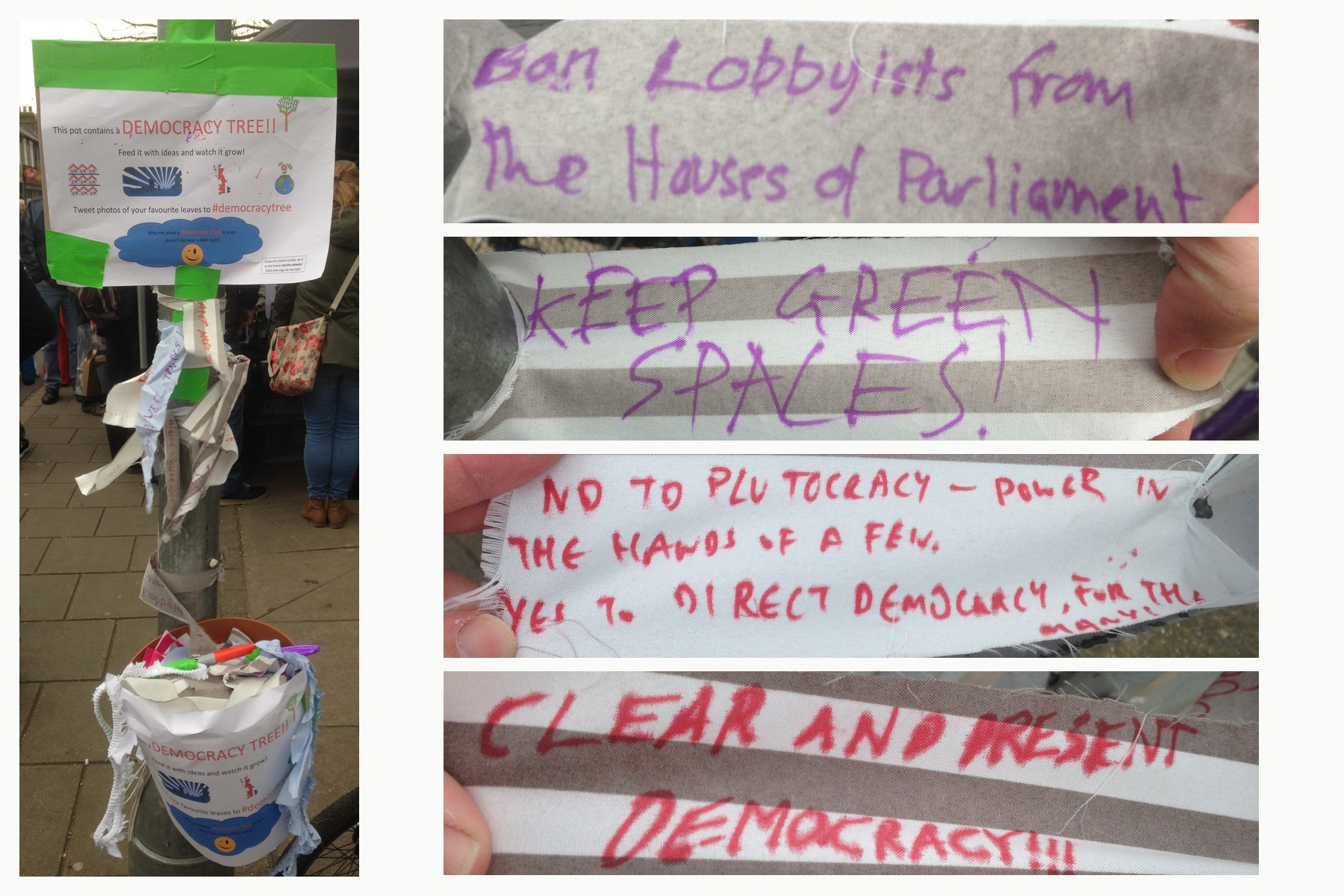
A pot of cotton tags, a pen on a piece of elastic and a post. People used it, and what they wrote was often sharp and good to read. It let people say what was wrong. It did not change anyone’s mind, mine included.
What I had in mind was grander: a democracy tree at the centre of every town. It would be a place where taking part cost so little that everyone had a voice and was listened to, and where hardship could be shared and solutions grown that worked for the people who would live with them.

In that tree each person is a leaf, and each group we belong to is a branch. The trouble is the arithmetic above. You can grow 69 million leaves. You cannot read them.
Drawing lots
There are two ways to read a book too long to finish.
The first is to let a machine do it. Landauer again: at Bell Labs in the late 1980s he co-invented latent semantic analysis, a piece of linear algebra that turns a pile of documents into a map of what they are about. Its descendants could map a national manifesto in hours. The map would show the shape of the tree: its branches, their size, and what distinguishes one from another. It would lose almost all the nuance.
The second way is to read a sample, properly. Choose pages at random from every part of the map, in proportion to its size, and give each page the attention that nobody could give the whole sheaf. Take the fingerprint of the whole, sample the parts, and listen closely to the sample.
That is sortition, stratified selection by lot, and the Athenians reached it two and a half thousand years ago. Their Council of Five Hundred was drawn by lot, fifty from each of the ten tribes. For their juries they built the kleroterion, a stone slab cut with columns of slots. Each citizen owned a pinakion, a small bronze plate engraved with his name and his deme, and slotted it into his tribe’s column. Black and white balls, released one at a time from a tube, decided which rows served. Several pinakia have been found in graves: the right to participate, cast in metal and kept to the end.
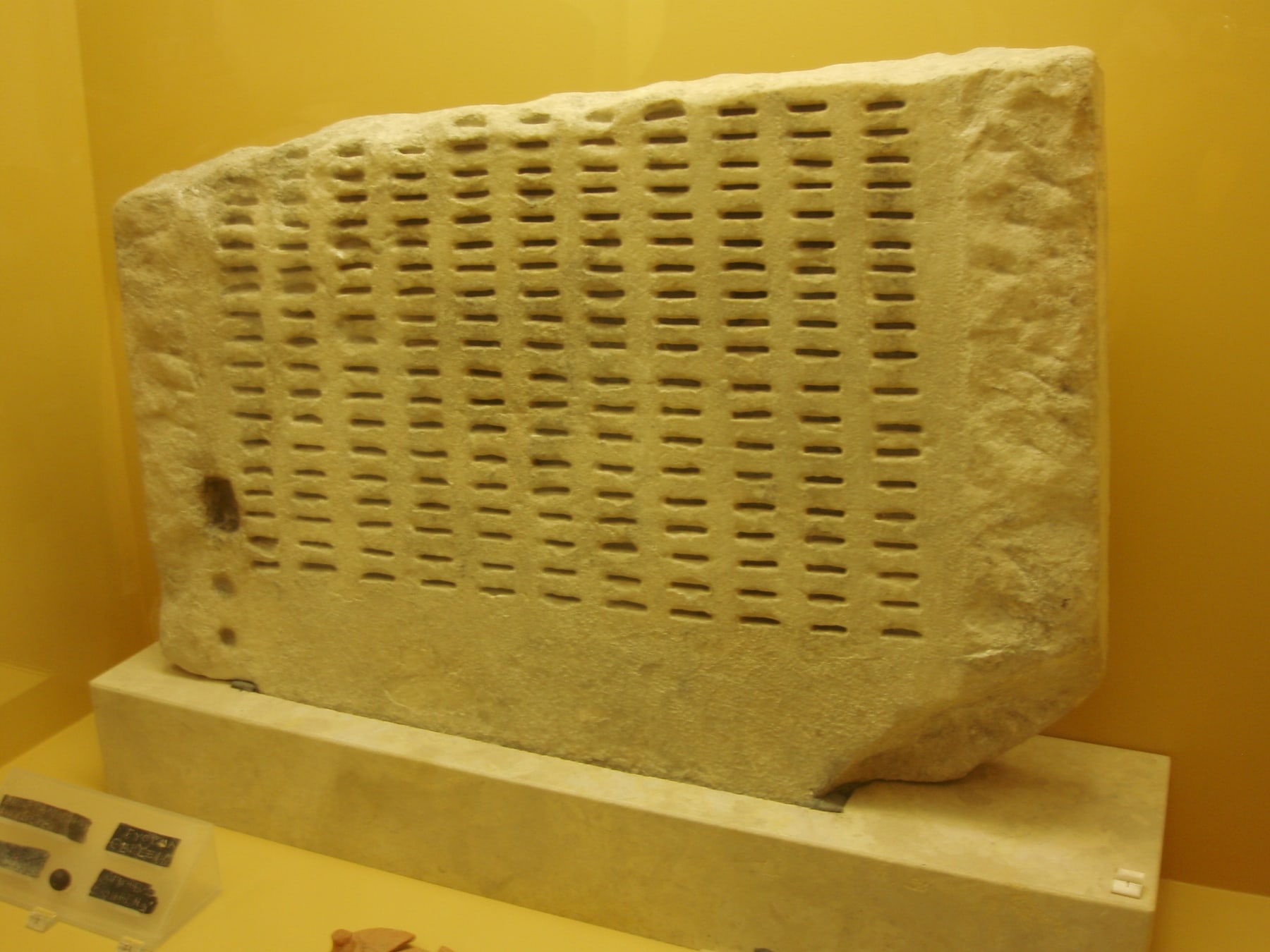
What makes the kleroterion worth our attention? Physically it was a civic instrument, in stone, standing in public and operating in daylight. It made selection unarguable. Nobody had to trust the officials, because anybody could watch.
The graphical image on this site’s front page works the same way. It divides the tree by whatever divides a society (party, region, industry, age, faith or none), allocates the seats across those branches in proportion to their size, and then draws at random within each.
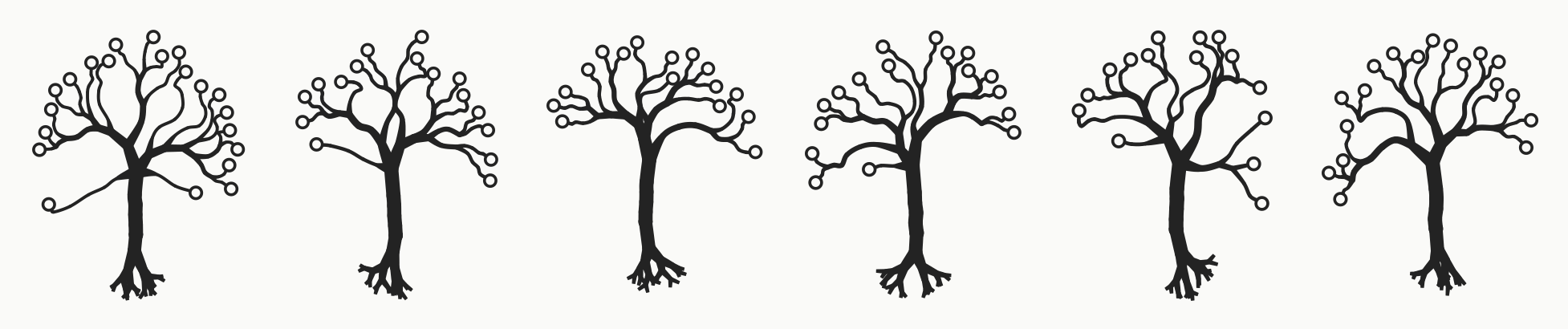
Nobody is chosen for who they are. The strata only fix the number from each location. Run the draw as often as you like: it will never settle on a favourite, because nothing in it could.
The picture makes one more thing obvious. A tree in which one branch takes over everything is not a healthy tree. In 2024 one party won almost two-thirds of the seats in the House of Commons on about a third of the vote. We would not accept one branch shading out the rest of the branches in an orchard. If you want a body that represents the whole canopy, you do not grow a branch. You draw from every branch at once, in proportion, at random.
The tree in the draw was made in the same spirit. It was not drawn but grown: its leaves were placed first, spread evenly across the canopy, and the branches then grew to reach them. The people come first, and the structure grows to serve them. The result looks less like a drawn tree than a neuron, a branching arbor with a small swelling at every tip. That is no mystery. Both solve the same problem: reach many points with as little wiring as possible, without letting any branch crowd the others. Trees do it for light, neurons for signals and road networks for traffic. A citizens’ assembly, if it is any good, forges such connections for argument.
Slow thinking
Sampling puts the right set of people in the room. It does not make them think.
Daniel Kahneman made the distinction familiar. Fast thinking is immediate, associative and cheap, and it is extraordinarily good at what it does, but it does not deliberate. Slow thinking is effortful and expensive, and nobody does it unless the conditions demand it.
Almost the whole of the modern information environment is built for the fast system: the headline engineered for outrage, the clip that confirms what you already know, the advertisement that works precisely because you do not examine it. That is not a failing of the people who respond. It is what the channel selects for. Propaganda is fast by necessity, because it stops working the moment it is examined. Deliberation is slow by necessity, because examination is the whole of what it does.
A deliberative assembly is a machine for making slow thinking happen. It takes people out of the torrent of neuronal candy for days at a time. It puts experts in front of them to be questioned rather than quoted, and seats them with people who disagree, in a room where walking away is not an option and a facilitator makes sure every voice is heard. None of this is natural. All of it is scaffolding, built around a process that would otherwise never start. At two bits a second, a few days is enough to learn something real about a subject, and a great deal about the strangers you learned it with.
The difference is easy to see from the inside. Here is a local government officer describing what happened when they replaced the usual public meeting with something deliberative:
Most people only attend local government public meetings to express opposition. … People typically arrive angry about the proposal they oppose and leave angrier having learned nothing. … [In the deliberative alternatives,] experts provid[ed] foundational information about the topic (“on tap” not on top) which then informed small group discussions among citizens and their elected officials. The difference in tone and outcome has been refreshing. … Each time, citizens found out there was more to the proposals under consideration than they realized and elected officials had a chance to hear from residents with a variety of viewpoints.
The flower
After Cambridge I became a project scientist at Northwestern University and, as a newly minted Fellow of the RSA, started Deliberation Gateway in 2018. At first it was simply a way to meet people who already studied and practised deliberation, both as a science and as a craft.
For years I spent Saturday mornings in conversation with two or three of them at a time. The conversations grew, and they drew in more people. My method, if it was one, was to spin a spider’s web: many light connections, all over the world, which together make something stronger than any single thread. I am far from the only person doing this, and nobody has mapped the whole field. Like the colony, it is an emergent thing that is rapidly taking over.
The image at the heart of all that is not the tree but a flower.

At its centre, two people are in conversation. Each petal is a sustained conversation with a different sector of society: faith, finance, industry, technology, non-violence. Each new sector adds a petal. Slowly Deliberation Gateway becomes a network of networks, anchored on a deliberative centre, and that is why the fleuron marks every section break on this site.
The flower is the entire thesis of this publication in one picture! Deliberation is not a topic among topics; one more thing to be polarised about alongside housing, energy and defence. It is the hub that lets the others cohere: the practice by which a society with genuine disagreements can decide to do something together, and mean it.
The sector assembly
The petals lead somewhere specific.
Every industry has backrooms where steering groups drawn from academia and business decide the fate of whole parts of the economy: artificial intelligence, pensions, industrial strategy. Their decisions are often technical, but many carry ethical and social weight that no committee, however well meaning, has the natural authority to settle. Citizens deserve a seat in those rooms. What they lack is not judgement but time and technical grounding, and that is exactly what a deliberative process supplies.
A sector assembly is a citizens’ assembly called by a sector itself, perhaps through its professional body. Citizens chosen by lot are given the time, the experts and the facilitation to reach a civic judgement: a considered verdict, in the spirit of a jury’s, on which the sector can build. The first two attempts to convene one grew directly out of the network: a Citizens’ Industrial Strategy and an inquiry into the stewardship of defined-benefit pensions. Both are documented in the Proceedings.
The programme
A network that runs for long enough accumulates arguments, recordings and half-finished papers, and eventually they need a permanent home: numbered, dated, citable and hard to quietly revise. That is why Deliberation Gateway is now also an imprint. It has its own series: a series of series.
- Origin: this overture, a definition of deliberative democracy and the case for the sector assembly.
- Gateways: short visions of what deliberation could change, for everyday people and for professional careers. Anyone may submit one for review.
- Proceedings: each attempt to get a sector assembly going, and the events held along the way.
- Conversations: recorded panels in the spirit of an RSA salon, one for each petal of the flower. How deliberative they managed to be is for you to judge.
- Foundations: thought experiments linking the physical sciences to a deliberative society. The two bits a second above are a first taste.
- The Open Table: a doctrine that treats society as a physical system, and asks which everyday decisions push it towards authoritarian or democratic outcomes.
- The Technical Body: the mathematics beneath the Foundations. It is held back for now while parts of it are under peer review.
- Event Reports: records of the events that produced something worth keeping.
Nothing here asks to be taken on trust. The arguments are numbered so they can be cited and attacked, the technical works state their weakest premise on purpose, and the records are kept verbatim. Where a claim is a definition it says so, and where an analogy is doing structural work, as the tree does here, it says that too.
For most of its life, Deliberation Gateway has been one person drifting between rooms and asking questions. The people in those rooms made it what it is, and the canon is as much theirs as mine. I would like it to become a we. If something here is worth arguing with, argue with it. If a sector you know needs a better conversation, get in touch.
End of work.